
Book Appointment Now

Composite Bonding and Composite Lamination Applications: Natural Smile Design in Beyoğlu and Galata
Composite bonding has become a prominent approach in recent years for those who want much more than “just white teeth” in smile aesthetics. Especially in areas such as Beyoğlu and Galata, where aesthetic expectations are high, composite bonding evaluates the shape, translucency, and facial harmony of the teeth together. When planned correctly, composite bonding stands out as an option that can preserve enamel, deliver fast results, and achieve a natural appearance. In composite bonding applications, the goal is not to achieve a single “white shade”; it is to create a lively aesthetic that suits the person’s skin undertone, lip line, and facial proportions. For this reason, composite bonding has become one of the most frequently searched procedures in Istanbul among those looking for minimally invasive smile design.
İçindekiler Tablosu - Table of Contents
- 1 What Is Composite Bonding?
- 2 Composite Laminate or Porcelain Laminate?
- 3 What Is a Mockup and Why Is It Important in Smile Design?
- 4 Why Do Composite Brands Matter in Bonding Treatment?
- 5 How Is Shade Selection Done in Aesthetic Bonding?
- 6 Why Are Brush Technique and Layering Important?
- 7 How Long Does Bonding Last?
- 8 Who Is Suitable for Composite Bonding?
- 9 Aesthetic Bonding and Smile Design in Beyoğlu & Galata
- 10 Why Is Teeth Whitening Important Before Bonding?
- 11 A Natural and Premium Bonding Approach in Istanbul
- 12 Frequently Asked Questions
What Is Composite Bonding?
Composite bonding is an aesthetic dental procedure performed by applying aesthetic composite materials to the front surface of the tooth with special adhesive systems, usually with no drilling or minimal enamel reduction. The critical point here is this: Composite bonding is not a procedure completed in one step like a standard “filling”; when performed in the right case, it is a layered design process that imitates the natural structure of the tooth.
With composite bonding, small gaps between teeth can be closed, minor fractures can be repaired, tooth length can be increased, and asymmetry can be balanced. In some patients, correcting the shape of a single tooth can make the entire smile look more balanced, while in others, composite bonding applied to several teeth can create a “minimal smile design” approach. The main reason why demand for composite bonding has increased around Beyoğlu and Galata through searches such as “natural Hollywood smile,” “no-prep veneer,” and “aesthetic bonding” is exactly this: a more natural look, less intervention, and faster transformation.
Composite Laminate or Porcelain Laminate?
Although this comparison is often asked as “which one is better?”, the correct question should actually be “which one is more suitable for which patient?” Because composite bonding and porcelain laminate are systems with different biomechanical requirements and respond to different expectations. The main factors determining the choice are the condition of the tooth enamel, bite relationship, smile line, teeth grinding habit, and the nature of the aesthetic expectation.
One of the strengths of the composite bonding and composite laminate approach is that it is conservative. In many cases, more enamel tissue can be preserved, and the procedure can be completed in a single session. In addition, in some cases, composite bonding can also be considered a reversible option; this is an important advantage, especially for young patients or people who say, “Let’s start minimally first.”
On the porcelain laminate side, advantages such as color stability and long-term surface gloss may be more noticeable. However, the planning and application steps of porcelain options are different. As a result, the answer to whether composite bonding or porcelain is better in the Beyoğlu–Galata area should be given individually through examination, photographic analysis, and bite evaluation.
What Is a Mockup and Why Is It Important in Smile Design?
In aesthetic dentistry, there is a major difference between “imagining the result” and “seeing the result.” Mockup is one of the most valuable stages that closes this gap. Thanks to mockup, the planned tooth form can be tested inside the mouth; lengths, proportions, and the effect of the smile line on the face can be understood before the procedure begins.
In composite bonding planning, mockup is not only an aesthetic preview; it also helps the dentist determine where to add volume and where to remain more conservative. Lip support, the visibility of the teeth during speech, and the harmony of the smile with facial expressions are also evaluated more clearly at this stage. Especially for people who want “minimal smile design,” mockup makes it easier to plan a natural, understated yet noticeable transformation.
Why Do Composite Brands Matter in Bonding Treatment?
Two things determine how natural a composite bonding result looks: the optical properties of the material and the dentist’s layering technique. Not every composite has the same translucency, the same opacity balance, or the same polishability. For this reason, the quality of the composite system used in premium aesthetic cases has a direct effect on long-term satisfaction.
For example, systems such as GC Europe and Tokuyama Dental are frequently preferred in aesthetic-focused cases due to features such as shade adaptation, enamel simulation, and the potential to preserve surface gloss. The goal here is not to create a “single-tone” whiteness, but to capture the micro-transitions that give natural teeth their vitality. Composite bonding can deliver a more sophisticated result with the right material selection; with the wrong material or incorrect finishing stage, the surface may become matte or create an artificial appearance.
How Is Shade Selection Done in Aesthetic Bonding?
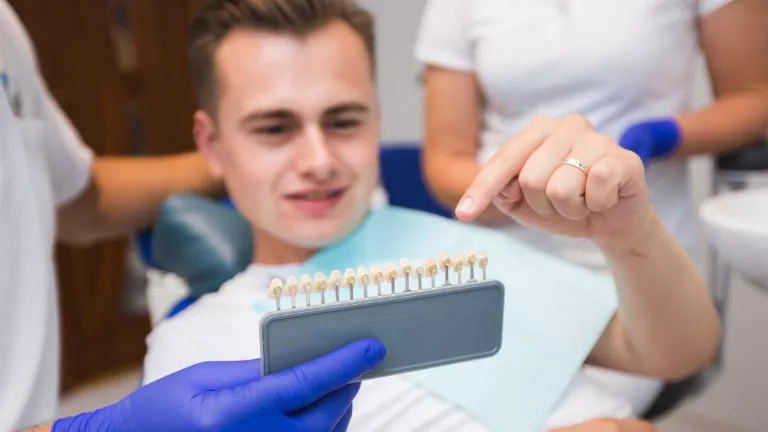
In a natural-looking composite bonding treatment, shade selection cannot be reduced simply to the question “BL1 or A1?” A natural tooth is not made up of a single color; the dentin core, enamel layer, and surface texture together create an “optical effect.” Therefore, in aesthetic composite bonding applications, dentin shades, enamel shades, and, when necessary, effect shades are often planned together.
Some patients want a brighter and more defined smile; in this case, the dentist can proceed with a brighter scale without disrupting harmony with the face. In some patients, the expectation of “I don’t want anyone to notice I had it done” becomes more important; in this case, a much softer aesthetic can be achieved with more natural shades such as A1/A2, by correctly managing surface texture and light reflection. The most important goal in composite bonding planning is to imitate the light play that makes the tooth look “alive.”
Why Are Brush Technique and Layering Important?
What makes a composite bonding application successful is not just placing the material on the tooth; it is shaping it according to anatomy, creating the micro-form, and completing the surface finish correctly. The layering technique helps control opacity, create the depth perception of a natural tooth, and avoid the appearance of a “single-piece plastic” structure.
Especially in front teeth, the incisal edge form, transition lines, surface micro-texture, and gloss level determine how the composite bonding result looks from both a distance and up close. In premium clinics in the Beyoğlu and Galata area, this is why not only “color” but also surface character, natural light reflection, and photographic analysis are included in the planning. Well-performed composite bonding does not look as if it has been added to the smile; it looks as if it has always been part of the smile.
How Long Does Bonding Last?
The lifespan of composite bonding applications cannot be discussed with a fixed number of years because many personal factors affect durability. The quality of the material used, correct finishing and polishing, the patient’s teeth grinding habit, tea and coffee consumption, smoking, and oral care routine all directly influence the result.
In cases where regular check-ups and maintenance are performed, composite bonding can be used aesthetically for many years. Another advantage of composite systems is this: If surface dullness or slight discoloration occurs over time, the appearance can often be revived with polishing and minor touch-ups. This makes the composite bonding approach valuable for people who want “aesthetic results that can be maintained with care.”
Who Is Suitable for Composite Bonding?
Composite bonding provides very successful results especially for small to medium-scale aesthetic needs and for those looking for a fast and conservative solution. Composite bonding can be an effective option for people with gaps between front teeth, minor fractures, those who want to minimally lengthen their teeth, or those aiming to correct symmetry.
However, not every case is ideal for composite bonding. In cases of advanced bite problems, severe teeth grinding, extensive restoration needs, or more complex color and form problems, combined planning with different treatments may be required. In some patients, the most accurate approach is to make the final touch with composite bonding after orthodontic correction. Therefore, the clear answer to the question “Is composite bonding suitable for me?” can only be given through detailed examination and personalized analysis.
Aesthetic Bonding and Smile Design in Beyoğlu & Galata
Around Beyoğlu and Galata, aesthetic dentistry has moved beyond the classical “treatment” approach and evolved into a planning-focused approach integrated with facial aesthetics. In premium composite bonding cases, only the teeth are not evaluated; facial proportions, lip support, smile line, the appearance of the teeth during speech, and photographic analyses are assessed together.
Especially when the goal is natural smile design, the composite bonding process is not carried out with a “single color – single layer” approach. Correct layering, correct contouring, and correct surface finishing determine how the tooth reflects light. For those seeking natural and premium results in Istanbul, the application technique becomes just as critical as planning when choosing composite bonding.
Why Is Teeth Whitening Important Before Bonding?
There is a clear reason why teeth whitening may be recommended before professional aesthetic composite bonding and composite laminate planning in some patients: Composite materials cannot be whitened like natural teeth after they are applied. Therefore, first bringing the natural tooth color to a more ideal shade and then designing the form and surface with composite bonding provides a more controlled process.
Especially in patients who want composite bonding only on the upper teeth, harmony with the color of the lower teeth is very important. When the lower teeth reach a brighter level through professional whitening, the composite bonding to be applied on the upper teeth allows for more flexible shade planning. This way, the dentist is not limited by the existing color and can create a tone and transition that harmonizes better with the face. The goal is still the same: not a “too white” look, but a lively and natural smile that reflects light correctly.
A Natural and Premium Bonding Approach in Istanbul
The goal in modern aesthetics is not to create teeth that look “done,” but to create a smile that blends naturally with the person’s face. Composite bonding serves this goal very effectively in the right case: minimal intervention, fast results, the ability to be touched up when needed, and strong natural-looking potential with correct layering.
Of course, a premium result does not come only from material quality, but from planning discipline and application precision. Photographic analysis, preview with mockup, bite control, and face–lip harmony transform the composite bonding process from an “aesthetic filling” level into a true design process. The growing popularity of composite bonding in areas such as Beyoğlu and Galata, where aesthetic expectations are high, is largely based on this.
Frequently Asked Questions
Does bonding damage the teeth?
Composite bonding performed in a suitable case, with correct isolation and proper adhesive protocol, is considered one of the treatments that preserves tooth tissue. Especially with no-prep or minimally invasive applications, the goal is to preserve enamel tissue as much as possible. The determining factors are the suitability of the existing tooth structure for bonding and the correct evaluation of bite forces.
Does composite bonding turn yellow?
- Composite bonding applications performed with high-quality materials have higher color stability; however, if surface maintenance is not done regularly, dullness and superficial staining may occur over time.
- Habits such as coffee, tea, and smoking may increase external staining on the composite bonding surface.
- Regular polishing and check-up appointments are very effective in preserving the gloss of composite bonding.
- An oral care routine, including brushing and interdental cleaning, is decisive in maintaining the lifespan and shade of composite bonding.
Is bonding or laminate veneer better?
The concept of “better” varies from person to person. Composite bonding offers a more conservative, faster, and in some cases reversible option. Laminate veneer, on the other hand, may provide higher color stability and longer-term surface gloss in some cases. The more suitable approach is determined by the condition of the tooth enamel, bite relationship, and the nature of the aesthetic goal.
Can bonding be done in a single session?
In many cases, composite bonding can be completed on the same day. However, as the scope expands, the process may take longer with the addition of steps such as planning, mockup, and photographic analysis. Even if a single session is possible, the goal is not “speed,” but correctly establishing form, symmetry, and naturalness.
Is mockup necessary?
Mockup is not mandatory; however, it creates a serious area of confidence in aesthetic planning. Before composite bonding is applied, allowing the patient to see the approximate result inside the mouth helps clarify decisions about length, proportion, and smile line. Especially in cases aiming for a “natural appearance,” mockup prevents small differences from creating major unwanted results.
What are the best bonding brands?
In premium aesthetic cases, systems such as GC and Tokuyama are frequently preferred because the optical behavior, layering compatibility, and polishability of these composites may be more predictable. Still, the result does not depend only on the brand; in the success of composite bonding, the dentist’s technique, isolation quality, and finishing–polishing stage are at least as important as the material.
What do composite bonding prices depend on?
Composite bonding prices may vary depending on how many teeth will be treated, the difficulty level of the case, the class of material used, the need for mockup/digital planning, and the dentist’s aesthetic experience. Once the needs are clarified through examination, a personalized plan is created based on both the scope of the procedure and the targeted aesthetic level. Contact us now for composite bonding prices.