
Book Appointment Now

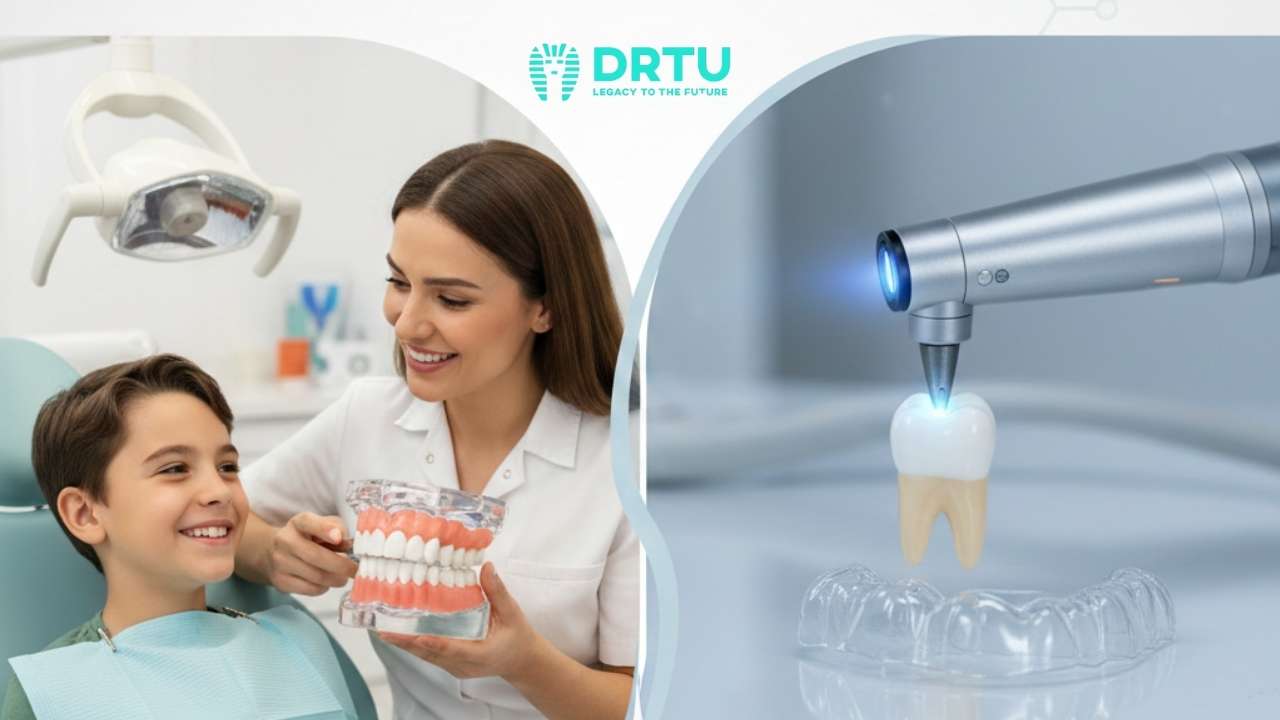
How Successful Are Non-Surgical Dental Treatments? Non-Surgical Solutions
For many patients, the dentist’s chair can be anxiety-inducing, especially when the word “surgery” is mentioned. The question, “Can I be saved with a non-surgical treatment without needing an operation?” is one of the most frequent questions patients ask when applying to our clinic. In modern dentistry, the fundamental principle is always to adopt a “preventive and conservative” approach. That is, the primary goal is to keep the natural tooth in the mouth whenever possible and to solve the problem without creating surgical trauma.
As an Oral, Dental, and Maxillofacial Surgeon, I must state that with interventions made at the right time, it is possible to achieve high success rates without the need for surgery.
İçindekiler
- 1 What is Non-Surgical (Conservative) Treatment?
- 2 The Critical Role of Early Diagnosis in Jaw Development and Oral Health
- 3 In Which Cases is Success Achieved Without Surgery?
- 4 3 Critical Factors Affecting Treatment Success
- 5 From a Surgeon’s Perspective: When is “Surgery” Necessary?
- 6 Don’t Be Late, Have an Option
- 7 Frequently Asked Questions (FAQ)
What is Non-Surgical (Conservative) Treatment?
Non-Surgical treatments are procedures performed without using a scalpel, without stitches, and without lifting tissue, generally aimed at stopping the progression of the disease and healing the tissue. These treatments usually include:
- Deep Periodontal Cleaning (Curettage): Non-surgical cleaning of infections in the gum pockets.
- Root Canal Treatment (Endodontics): Non-surgical healing of infections at the root tip and certain cystic structures.
- Laser Applications: Sterilization of infected tissues using laser energy.
- Joint Splints and Botulinum Toxin: Non-surgical management of temporomandibular joint (TMJ) disorders and teeth grinding issues.
The Critical Role of Early Diagnosis in Jaw Development and Oral Health
Jaw development, the position of the teeth, and intraoral functions are structural elements that affect an individual’s lifelong aesthetic and functional health. Interventions made especially until the end of adolescence can prevent major surgical procedures that might be needed in the future.
1. Early Orthodontic Intervention in Children and Adolescents
While jaw development continues between the ages of 8–17; when jaw narrowness, lower-upper jaw retrognathism, and closure disorders are noticed early, development can be guided in the right direction with orthodontic braces and orthopedic appliances. In this way, while respiratory and chewing functions improve, a large portion of orthognathic jaw surgeries that might be required in adulthood can be prevented.
2. Not Ignoring Small Fractures and Traumas
Even seemingly very small tooth fractures or enamel cracks can lead to pulp (nerve) damage and the need for root canal treatment over time. Every trauma that seems like “something small” should be evaluated by a physician before it pushes the tooth to the surgical limit.
3. Teeth Grinding (Bruxism) and the Risk of Tooth Loss
Untreated teeth grinding causes enamel loss, widespread fractures, and temporomandibular joint (TMJ) pain. Night guards and botulinum toxin treatment applied in the early period protect the teeth and prevent major restorations or tooth extractions that may be required in the future.
4. Preventive Approach to Enamel Weakness and Sensitivities
When cold-hot sensitivity is caught early; tooth vitality is preserved with protective fillings, fluoride applications, and enamel-strengthening treatments. Being late makes the treatment more costly and invasive.
In Which Cases is Success Achieved Without Surgery?
The success of non-surgical treatments is directly proportional to the “stage” of the disease.
- Early-Stage Gum Diseases: In cases of Gingivitis and early-stage Periodontitis, non-surgical methods provide a success rate of 80-90%. If the gum pocket is below 5mm, these methods are the gold standard.
- Root Tip Infections: Not every lesion seen on an X-ray requires surgery; with a good root canal treatment, the body can heal the area. Our priority is to keep the tooth in the mouth instead of extracting it and performing an implant.
- Temporomandibular Joint (TMJ) Problems: Surgery is the last resort for jaw clicking or pain. Methods such as night guards, physical therapy, and Botox significantly increase the quality of life.
3 Critical Factors Affecting Treatment Success
- Early Diagnosis: If the problem is intervened before it progresses to the bone tissue, the possibility of surgery decreases.
- Patient Compliance: Following the oral hygiene rules recommended by the physician ensures the permanence of the treatment.
- Use of Technology: Advanced imaging and laser technologies can pull even cases at the surgical limit to the non-surgical side.
From a Surgeon’s Perspective: When is “Surgery” Necessary?
In some cases, surgery is the most protective way to solve the problem at its root and prevent larger losses. Surgical intervention may be required in very advanced bone loss, risky impacted wisdom teeth, large cysts that do not heal with root canal treatment, and extreme gum recession. However, today these procedures are much more comfortable with “minimally invasive” techniques.
Don’t Be Late, Have an Option
The success of non-surgical treatments is high, but this success is limited by “timing.” Every complaint you postpone brings you one step closer to the surgical limit. Problems such as jaw narrowness and developmental delay in children, and teeth grinding and enamel weakness in adults, can be solved before they grow with early diagnosis. To find out whether your condition requires surgery, you can have a detailed examination by meeting with Dr. Tansu Uzel. You can review treatment examples via Instagram.
Frequently Asked Questions (FAQ)
Question: Does the use of lasers in gum treatment count as surgery? Answer: No, laser-assisted treatments fall into the category of non-surgical methods and the healing process is very fast.
Question: Is non-surgical gum treatment painful? Answer: Since it is performed under local anesthesia, no pain is felt and the recovery process is much more comfortable compared to surgery.