
Book Appointment Now

Khoury Technique Ramus Hard Tissue Graft and Advanced Bone Deficiency Treatment | Istanbul Beyoğlu Galata
Ramus Hard Tissue Graft with the Khoury Technique is a special surgical method used to make implant treatment possible in patients with advanced jawbone loss. Ramus Hard Tissue Graft with the Khoury Technique offers a strong and biologically advantageous treatment option, especially for patients seeking advanced jaw surgery in the Istanbul Beyoğlu Galata area. Long-term tooth loss, trauma, infections, periodontal diseases or certain systemic conditions may lead to severe volume loss in the jawbone over time. This loss not only makes implant placement more difficult, but may also negatively affect chewing quality, facial support, lip form and overall oral health.
In the treatment of advanced bone deficiency, the aim is not only to replace the missing tissue. The main goal is to create a strong, vital and high-quality bone foundation that can support the implant healthily for many years. Therefore, in cases where conventional bone augmentation methods are insufficient, Ramus Hard Tissue Graft with the Khoury Technique is considered an important alternative. Using the patient’s own bone increases biological compatibility and contributes to a more natural healing process.
İçindekiler Tablosu - Table of Contents
- 1 What Is the Khoury Technique?
- 2 Why Is Bone Taken from the Ramus Area?
- 3 How Is Ramus Grafting Performed with the Khoury Technique?
- 4 Strengthening Bone Formation with PRF Support
- 5 The Importance of Membrane Use
- 6 Who Is It Suitable For?
- 7 Advantages Provided by the Treatment
- 8 Advantages of the Khoury Technique Compared to Ramus Block Bone Grafts
- 9 Digital Planning and Three-Dimensional Surgical Analysis
- 10 Local Anesthesia or General Anesthesia Option
- 11 Healing Process
- 12 Bone Deficiency Treatment with the Khoury Technique in Istanbul Beyoğlu Galata
What Is the Khoury Technique?
The Khoury Technique is an advanced bone reconstruction method using thin cortical bone plates obtained from the patient’s own jawbone. In this technique, the natural structure of the jawbone is taken as a model. In healthy bone, the outer part consists of hard cortical bone, while the inner part contains cancellous bone, which is a more vascular and vital structure. In Ramus Hard Tissue Graft with the Khoury Technique, a similar biological architecture is aimed to be created.
The most important difference of this method is that the missing bone is not only increased in volume, but also reshaped into a structure similar to natural bone. Cortical bone plates act like a frame. Inside this frame, particulate bone graft prepared from the patient’s own bone is placed. In this way, a healing area that is both durable and has high vascularization potential is obtained.
In patients with advanced bone loss, there may not be sufficient height or width for implant treatment. In this case, direct implant placement may not be possible, or its long-term success may be at risk. Since the Khoury Technique aims to reconstruct the bone before implant placement, it is especially preferred in cases of advanced jawbone resorption.
Why Is Bone Taken from the Ramus Area?
The ramus area is one of the strong and dense cortical bone regions located at the back of the lower jaw. Due to its hard structure and biological properties, this area stands out as one of the commonly used donor sites in the treatment of advanced bone deficiency. During Ramus Hard Tissue Graft with the Khoury Technique, the bone taken from the ramus area is highly compatible with the body because it belongs to the patient’s own tissue.
The main reasons for choosing the ramus area are as follows:
- It has a dense and durable cortical bone structure.
- It helps create a strong bone foundation for implant surgery.
- Since the patient’s own tissue is used, its biological compatibility is high.
- It can provide effective results in advanced horizontal and vertical bone loss.
- It is advantageous in terms of creating long-term stable bone volume.
- Since it can be accessed from inside the mouth, it does not require an additional skin incision.
The bone taken from the ramus area can be used both efficiently and safely with proper surgical planning. At this point, the surgeon’s experience, three-dimensional analysis and a personalized treatment plan are highly important.
How Is Ramus Grafting Performed with the Khoury Technique?
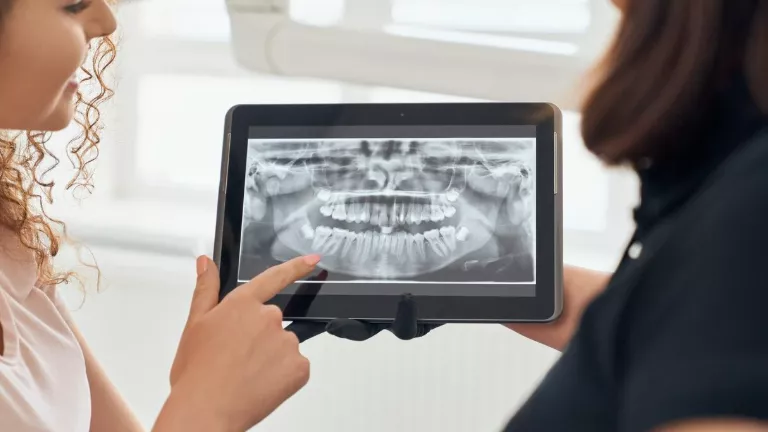
Before planning Ramus Hard Tissue Graft with the Khoury Technique, the patient’s jaw structure is evaluated in detail. The amount of bone loss, the position of nerves, existing bone thickness and the space required for the implant are analyzed through panoramic X-ray, three-dimensional dental tomography and intraoral examination. This evaluation is the basic step for the surgery to proceed safely and predictably.
During the procedure, thin cortical bone plates are first obtained from the ramus area with the help of special surgical devices. These plates are prepared according to the area where bone deficiency is present. They are then fixed around the deficient area with titanium screws, leaving a certain space. This space forms the biological area where new bone will develop.
The remaining part of the bone taken from the ramus area is particulate using special systems and turned into an autogenous bone graft. The obtained bone particles are placed into the space created between the cortical plates. In this way, a structure is prepared with a hard cortical bone outer part and a more vital, highly vascularization-potential particulate bone inner part. This approach helps imitate the natural architecture of bone.
During closure of the surgical area, tension-free closure of the soft tissues is important. For the graft to heal healthily, the area must be protected from infection, its blood supply must be supported and the soft tissue must remain stable. Therefore, the procedure should be considered a treatment that requires advanced surgical experience and precise planning.
Strengthening Bone Formation with PRF Support
In some cases, PRF support may also be used in Ramus Hard Tissue Graft with the Khoury Technique procedures. PRF is a biological material obtained from the patient’s own blood and rich in growth factors. Blood taken from the patient before the surgical procedure is prepared in special devices, and a fibrin structure is obtained.
The purpose of PRF is to biologically support the healing process. PRF placed inside the bone graft or in the surgical area may contribute to more controlled tissue healing. Especially in patients with advanced bone loss, vascularization of the graft area, soft tissue healing and the quality of new bone formation are highly important.
This support is not a bone-forming method on its own; however, when used together with the Khoury Technique, it can provide biological contribution to the treatment process. The patient’s general health status, blood values, smoking habits, oral hygiene and the characteristics of the surgical area are among the factors affecting the success of this process.
The Importance of Membrane Use
The use of membranes in bone grafting procedures is an important step in protecting the newly forming bone. After Ramus Hard Tissue Graft with the Khoury Technique, biological membranes may be applied over the placed graft material. These membranes help limit the movement of soft tissues toward the bone formation area.
During the healing process, while the body tries to repair the surgical area, soft tissue cells may move faster than bone cells. If the graft area is not protected sufficiently, the space where bone should form may become filled with soft tissue. Membrane use is preferred to reduce this risk and to create a more controlled environment for bone development.
Correct membrane selection plays an important role in the success of the surgical technique. The type of membrane to be used is determined according to the size of the bone loss, the location of the graft area and the patient’s healing capacity.
Who Is It Suitable For?
Ramus Hard Tissue Graft with the Khoury Technique is a method evaluated in patients who do not have sufficient jawbone for implant treatment and who experience advanced bone deficiency. The suitability decision must be made after clinical examination and three-dimensional imaging.
This treatment may be especially suitable for the following patients:
- Those who experience jawbone resorption due to long-term toothlessness
- Those who do not have sufficient bone height or width for implants
- Patients with vertical bone loss
- People with horizontal bone loss
- Individuals who develop bone loss after trauma
- Patients who were previously told that implants could not be placed
- Those who experience aesthetic and functional problems due to advanced jawbone loss
- Patients who do not have a condition preventing bone harvesting from the ramus area
The same treatment protocol is not applied to every patient. Age, general health status, oral hygiene, the amount of bone loss, medications used and expectations directly affect the treatment plan.
Advantages Provided by the Treatment
Ramus Hard Tissue Graft with the Khoury Technique does not only aim to create bone volume for implant placement. It may also increase the functional and aesthetic support of the jawbone. In advanced bone loss, chewing forces cannot be distributed properly, and this may affect bite alignment, joint health and facial profile over time.
Reconstructing bone volume helps implant treatment to be performed on a stronger foundation. This is important for the long-term success of implants. In addition, supporting the jawbone may positively affect lip support, facial height and the appearance of soft tissues around the mouth.
In people who have remained toothless for a long time, collapse in the lower facial area, loss of lip support and an aged appearance may occur. Thanks to advanced bone deficiency treatment, not only intraoral functions but also facial aesthetics can become more balanced. Therefore, Ramus Hard Tissue Graft with the Khoury Technique is considered a valuable procedure both surgically and aesthetically.
Advantages of the Khoury Technique Compared to Ramus Block Bone Grafts
In traditional ramus block bone grafts, the harvested bone block is placed in the deficient area, and a generally longer healing period is required for maturation. In some cases, this process may vary between 6 and 8 months. Ramus Hard Tissue Graft with the Khoury Technique is based on a different biological principle.
In this technique, cortical plates and particulate autogenous bone are used together. While the cortical plates provide shape and stability to the area, the particulate bone graft creates a more active healing zone. When PRF support and membrane use are also included in the process, a more controlled and vital bone formation is targeted.
In many cases, bone volume suitable for implant placement can be obtained within approximately 4 months. Of course, this period may vary depending on the patient’s healing capacity, the extent of bone loss, the condition of the surgical area and the dentist’s clinical evaluation. The prominent feature of the Khoury Technique is its potential to create higher-quality bone with long-term stability by imitating the cortical and cancellous structure of natural bone.
Digital Planning and Three-Dimensional Surgical Analysis
In advanced bone deficiency treatments, digital planning is one of the most important stages that directly affects the success of surgery. Before Ramus Hard Tissue Graft with the Khoury Technique, the height, width and depth of bone loss are analyzed in detail using three-dimensional dental tomography.
Thanks to this analysis, nerve canals, anatomical spaces, neighboring tooth roots and the future positions of the implants to be placed can be evaluated in advance. Especially in patients from whom bone will be harvested from the ramus area, the position of nerve tissues must be carefully examined. Therefore, clinical examination alone is not sufficient; three-dimensional imaging is an indispensable part of the treatment plan.
When digital intraoral scanners and tomography data are used together, it becomes possible to position implants in harmony with future prosthetic planning. In this way, not only bone formation but also the implant and prosthetic treatment to be placed on that bone can be planned correctly.
Local Anesthesia or General Anesthesia Option
Ramus Hard Tissue Graft with the Khoury Technique can be performed under local anesthesia depending on the scope of the case. In more limited bone deficiencies, local anesthesia is usually sufficient. The patient does not feel pain during the procedure, and the surgical area is numbed in a controlled manner.
In more extensive bone loss, cases where more than one area will be treated or cases where the patient experiences intense anxiety, the option of general anesthesia may be considered. The decision for general anesthesia is made by taking into account the patient’s medical history, procedure duration, surgical scope and expectations.
In both anesthesia options, the main aim is to ensure patient comfort and help the surgical procedure be completed safely. The most appropriate method is determined with a detailed evaluation before treatment.
Healing Process
After Ramus Hard Tissue Graft with the Khoury Technique, the healing process requires biological time. New bone formation consists of the vascularization of the placed graft, its integration with tissues and its maturation stages. In most cases, radiological evaluation is performed after a waiting period of approximately 4 months.
In this control, the obtained bone volume, density and suitability for implants are examined. When the bone reaches sufficient maturity, implant treatment can begin. During the healing process, it is extremely important for the patient to pay attention to oral hygiene, use the prescribed medications regularly, avoid smoking and not miss follow-up appointments.
Mild swelling, sensitivity or limited mouth opening may be seen in the first days after surgery. These are usually expected temporary conditions. However, in cases such as prolonged pain, bad odor, discharge or opening in the suture area, the dentist should be consulted without delay.
Bone Deficiency Treatment with the Khoury Technique in Istanbul Beyoğlu Galata
In Istanbul Beyoğlu Galata, Ramus Hard Tissue Graft with the Khoury Technique procedures are special treatments that require advanced jaw surgery experience and detailed digital planning. Pre-implant bone formation, ramus block bone grafts, advanced bone reconstruction and jawbone resorption treatments should be planned individually for each patient.
At our clinic, patients with advanced bone deficiency are examined in detail with panoramic X-ray, three-dimensional dental tomography and intraoral evaluation. In this way, the level of bone loss is determined, the necessary foundation for the implant is planned and the most suitable surgical approach is created for the patient.
In many cases where patients were previously told that implants could not be placed, implant treatment may become possible again with the correct technique and proper planning. Ramus Hard Tissue Graft with the Khoury Technique is a modern treatment approach that aims to create a strong, natural-like and long-term stable bone foundation in patients with advanced bone loss. In Istanbul Beyoğlu Galata, a personalized solution can be created with a detailed examination for advanced bone deficiency treatment, pre-implant bone formation and jaw surgery planning.