
Book Appointment Now

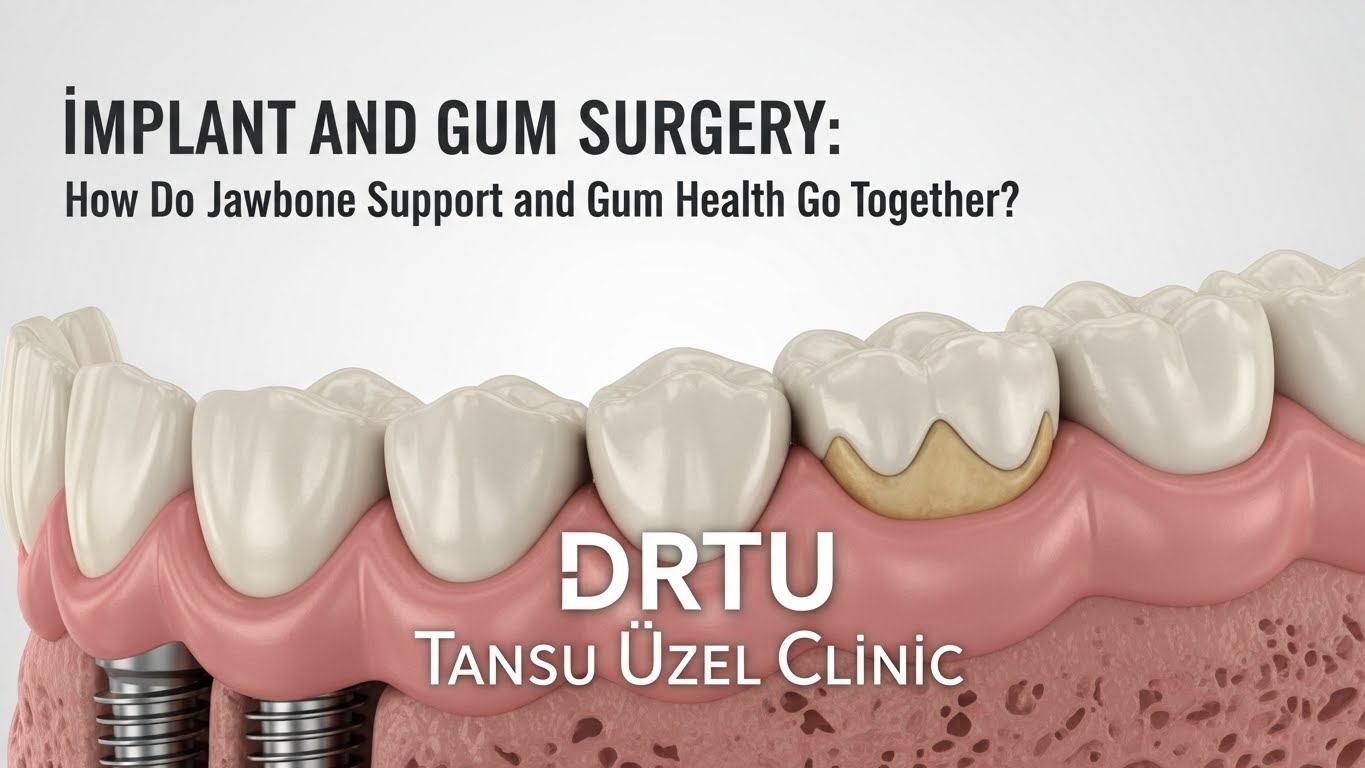
Implant and Gum Surgery: How Jawbone Support and Gum Health Progress Together
Dental implants are one of the most natural and long-lasting solutions for missing teeth today. However, implant success depends not only on placing the titanium screw into the bone, but also on having sufficient jawbone and healthy gum tissue. For this reason, implant and gum surgery are often two closely related processes.
In this article, we examine in detail how implant and gum surgery progress together, why jawbone support is so critical, and how to maintain healthy gums around the implant.
İçindekiler
- 1 Why Is Implant Treatment Dependent on Gum and Jawbone Health?
- 2 Why Is Gum Surgery Included in This Process?
- 3 1. Jawbone Deficiency: Pre-Implant Surgical Interventions
- 4 2. Gum Surgery: The Most Important Protective Shield of the Implant
- 5 Importance of Connective Tissue and Attached Gingiva in Implant Treatment (New Section)
- 6 3. Balance Between Implant and Gum Surgery – How Do They Work Together?
- 7 4. How to Maintain Gum Health After Implant Placement?
- 8 5. Effects of Suturing Techniques on Healing (New Section)
- 9 6. Evaluating Treatment as a Whole (New Section)
- 10 7. Examples From Daily Life
- 11 Solid Jawbone and Healthy Gums Are the Two Essential Requirements for a Successful Implant
Why Is Implant Treatment Dependent on Gum and Jawbone Health?
A dental implant relies on three fundamental structures:
- Solid jawbone
- Healthy gum tissue
- An infection-free oral environment
If there is a problem with any of these three, the long-term success of the implant may be affected.
Why Is Gum Surgery Included in This Process?
Because the gums form a natural barrier that protects the area around the implant.
Healthy gums → prevent bacteria from entering the implant neck → reduce the risk of peri-implantitis.
1. Jawbone Deficiency: Pre-Implant Surgical Interventions
For an implant to be placed, the jawbone must have:
- Sufficient height
- Sufficient width
- Sufficient density
If these values are insufficient, some surgical procedures are performed before the implant:
Bone Graft Application
Natural or synthetic bone powder is added to the missing area.
The graft integrates with the patient’s own bone over time.
Sinus Lifting
In the upper jaw posterior region, the sinus may sag, causing insufficient bone.
This procedure elevates the sinus floor and strengthens the implant area.
Block Bone Graft
In cases of larger bone loss, block bone is taken from the jaw or donor sites and placed in the deficient region.
Daily example:
For many patients who are told “Implant cannot be placed in my back tooth region,” the issue is simply insufficient bone volume, and implants can be placed successfully after grafting.
2. Gum Surgery: The Most Important Protective Shield of the Implant
Gum surgery plays a critical role in the aesthetic and functional success of an implant.
Why?
- Healthy gum tissue surrounds the implant neck.
- It prevents bacteria from entering around the implant.
- Implant loss is more common when gum tissue is insufficient.
Gum Surgeries That May Be Needed
Soft Tissue Graft
If the gum around the implant is thin or receded, a free tissue graft is used to strengthen the area.
Crown Lengthening or Aesthetic Gingivectomy
Supports smile aesthetics and creates a healthy gum line.
Peri-implantitis Treatment
The infected tissue around the implant is cleaned and reshaped.
Importance of Connective Tissue and Attached Gingiva in Implant Treatment (New Section)
For implant treatment to be long-lasting and healthy, there must be a sufficient amount of healthy connective tissue and attached gingiva in the area where the implant will be placed. These tissues act as a natural barrier protecting the implant.
If this tissue is insufficient, even if the implant can be placed, it is not possible to safely place the prosthesis on top. In such a situation:
- The area becomes more prone to infection,
- Pain may develop,
- The risk of implant loss increases.
Additionally, insufficient attached gingiva means the gum is mobile, which can lead to:
- The prosthesis not staying stable,
- Sliding,
- Irritation and sore formation.
For all these reasons, strengthening the soft tissue before starting implant treatment is critical both for long-term success and patient comfort.
3. Balance Between Implant and Gum Surgery – How Do They Work Together?
Implant → Supports the bone
It transmits chewing forces to the bone by serving as an artificial tooth root.
This prevents jawbone resorption.
Gums → Protect the implant
Healthy and tight gum tissue covers the implant neck and prevents the entry of bacteria.
Together → They imitate the function of a natural tooth.
Therefore, both the bone and the gum are equally important in implant treatment.
4. How to Maintain Gum Health After Implant Placement?
Once an implant is placed, oral care becomes even more important.
Special Attention to Oral Hygiene
- Use a soft toothbrush
- Clean the implant neck with an interdental brush
- Recommendation of water flosser
- Regular professional cleaning
Avoid Tobacco Products
Smoking slows healing and increases the risk of implant loss.
Regular Check-Ups
The implant area should be checked every 6 months for both bone and gum health.
5. Effects of Suturing Techniques on Healing (New Section)
It is very important that the sutures used to close the surgical site after implant placement are done regularly, symmetrically, and with proper technique.
Proper suturing:
- Keeps the wound stable,
- Helps tissues fuse in the correct position,
- Reduces the risk of infection.
If sutures are not placed properly:
- Wound edges may not close fully,
- Healing may be delayed,
- Infection risk increases,
- Gum recession or aesthetic issues may occur.
Therefore, in implant surgery, not only the placement of the implant but also the meticulous closure of the tissue is a critical step for long-term success.
6. Evaluating Treatment as a Whole (New Section)
Successful implant treatment is not only about placing the implant into the bone.
The treatment requires harmony among many components such as:
- Prosthetic planning,
- Gum health,
- Soft tissue aesthetics,
- Surgical technique
Implants placed without adequate connective tissue and attached gingiva will not be stable in the long term, infection risk increases, and prosthetic incompatibilities may occur.
Therefore, implant treatment is a multi-step process, and each step must be completed under ideal conditions.
7. Examples From Daily Life
Example 1: “I have an implant, but my gums have receded. What should I do?”
Gum recession can expose the implant neck. In this case, a soft tissue graft is performed to strengthen the area.
Example 2: “They said I don’t have enough bone. Can I still get an implant?”
Yes. After bone grafting or sinus lifting, implant placement is possible in most cases.
Example 3: “My implant frequently becomes inflamed.”
This may be peri-implantitis; if not treated early, it can lead to implant loss.
Solid Jawbone and Healthy Gums Are the Two Essential Requirements for a Successful Implant
For implant treatment to be long-lasting, maintaining gum health is as critical as having sufficient jawbone.
Dr. Tansu Uzel evaluates implant and gum surgery together and offers personalized, safe, and aesthetic solutions for each patient.