
Book Appointment Now

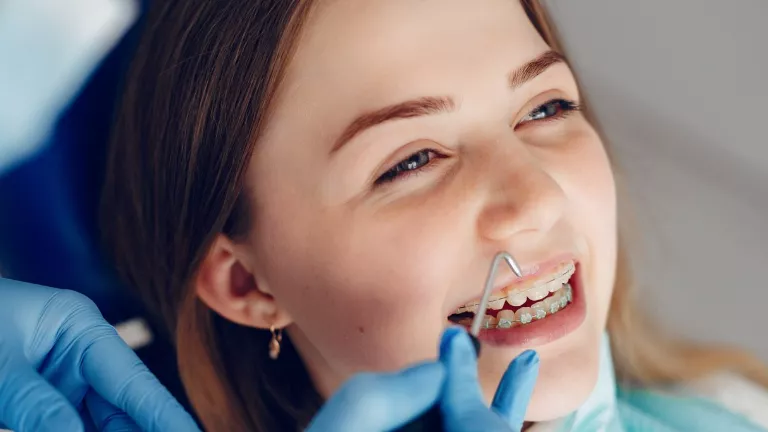
Orthodontic Treatment
İçindekiler Tablosu - Table of Contents
- 1 What Is Orthodontic Treatment?
- 2 Who Is It Suitable For?
- 3 Types of Braces: Metal, Ceramic, and Lingual
- 4 Clear Aligner Option
- 5 How Long Does Orthodontic Treatment Take?
- 6 How Is an Orthodontic Treatment Plan Created?
- 7 Braces Pain and Irritation: What Is Normal and What Is Not?
- 8 Why Is Retention (Retainer) Necessary After Treatment?
- 9 Orthodontic Treatment Prices 2026
- 10 Frequently Asked Questions
- 10.1 What is the best age for orthodontic treatment?
- 10.2 Braces or clear aligners: which is better?
- 10.3 Does orthodontic treatment hurt, and how long does the pain last?
- 10.4 Can tartar cleaning be performed while wearing braces?
- 10.5 Can teeth shift again after treatment, and how long should a retainer be worn?
- 10.6 What should be done if a brace breaks or an elastic snaps?
What Is Orthodontic Treatment?
Orthodontic treatment is a planned correction process that helps the teeth and jaws close in a more balanced way. This process is not only for aesthetic purposes. Improving chewing comfort is also an important goal. Easier cleaning of the teeth is another objective.
Treatment can be performed with fixed braces or clear aligners. The preferred method depends on the oral structure. In some patients, only tooth alignment is corrected. In others, the bite relationship is also addressed. Regular check-ups, good oral hygiene, and following the dentist’s plan determine treatment success.
Who Is It Suitable For?
Orthodontic treatment is suitable for children and adults with crowding, spacing, and bite problems. Protruding front teeth are a common reason for consultation. Crossbite and a retruded lower jaw are also important concerns. Not only children but adults can also receive treatment. Age alone is not considered a barrier.
However, gum health and oral hygiene should be sufficient. In children, the first evaluation may be performed earlier. Specialists recommend the first orthodontic check-up around the age of seven. Final suitability becomes clear after examination and records are completed.
Types of Braces: Metal, Ceramic, and Lingual
Braces options include metal, ceramic, and lingual systems. Metal braces stand out for their durability. Ceramic braces appear closer to the natural tooth color. For this reason, they are often considered by patients with higher aesthetic expectations. Lingual systems are placed on the inner surfaces of the teeth.
This makes them less visible from the outside. However, not every system is suitable for every case. Appearance should not be the only factor in choosing a system. Ease of cleaning, case complexity, and daily comfort should also be evaluated together. The most suitable option should be determined individually after examination.
Clear Aligner Option
Clear aligners are removable orthodontic options that gradually move the teeth. These aligners apply light and continuous force to the teeth. Since they can be removed during meals, they make daily life easier. They also provide comfort while brushing. Their less noticeable appearance is an important aesthetic advantage.
However, regular use is essential for successful results. Many sources recommend wearing them approximately 22 hours per day. They are frequently preferred in mild and moderate cases. They may also be used in more complex situations, but suitability varies from person to person.
How Long Does Orthodontic Treatment Take?
Orthodontic treatment usually takes between 6 and 30 months in most cases. Mild irregularities may be corrected more quickly. More complex bite problems may require a longer period. The initial problem is not the only factor affecting treatment time. Missing appointments may also prolong the process.
Broken brackets and irregular aligner use can also affect treatment duration. Some patients may require additional correction stages. Therefore, the timeline given during the first consultation is only an approximate guide. A clearer schedule is understood once the treatment plan is completed.
How Is an Orthodontic Treatment Plan Created?
An orthodontic treatment plan is prepared individually after examination and detailed records. In the first stage, tooth alignment and bite relationships are evaluated. Photographs may be taken and digital scans performed. X-rays may also be requested if necessary. These records help clarify the source of the problem.
If there are cavities or gum problems, they are treated first. Then the appropriate system is selected. Follow-up intervals and estimated treatment duration are also discussed at this stage. Proper planning is very important for achieving more balanced and predictable results.
Braces Pain and Irritation: What Is Normal and What Is Not?
Mild pain and irritation after braces are placed are generally considered normal. A feeling of pressure may be expected during the first days. Some people experience friction inside the lips and cheeks. These complaints usually decrease within a few days. Pain lasting two or three days is generally considered normal. Orthodontic wax may help with irritation. However, if the wire cuts the cheek, attention is necessary. Severe sores, significant bleeding, or swallowing difficulties are not considered normal. In such situations, the clinic should be contacted.
What Should Be Considered for Nutrition and Oral Care?
During treatment, hard foods should be avoided and oral care should be improved. Sticky and very hard foods may damage the brackets. Sugary and acidic foods can also increase risk. Since braces can trap food, cleaning becomes more important. Brushing should be done more carefully.
Interdental cleaning should also not be neglected. In patients using clear aligners, aligners should not be worn before brushing the teeth. Without regular care, plaque accumulation may increase. This may lead to cavities and gum problems. Good hygiene directly contributes to maintaining healthy results.
Why Is Retention (Retainer) Necessary After Treatment?
A retainer is very important after treatment because it helps prevent the teeth from returning to their previous positions. The process is not completely finished once the teeth are corrected. Surrounding tissues need time to adapt to the new position. For this reason, the retention phase is considered part of the treatment. Retainers may be fixed or removable.
The most suitable option depends on the structure of the case. Some clinics recommend nighttime use during the first year. Later, less frequent use may be planned. If retainers are not used regularly, the teeth may shift again. This phase should not be neglected to maintain long-term results.
Orthodontic Treatment Prices 2026
Prices in 2026 may vary depending on the tooth structure and treatment details. Dental treatments are offered within different price ranges according to the preferred procedure, aesthetic expectations, and durability features.
Frequently Asked Questions
What is the best age for orthodontic treatment?
The age of seven is considered an important time for the first orthodontic evaluation. This does not mean active treatment will begin for every child at this age. However, it is valuable for identifying developmental problems early. The eruption pattern of permanent teeth can be monitored more effectively during this period.
For some children, observation alone may be sufficient. In others, early intervention may provide advantages. For adults, there is no strict upper age limit. Treatment may be planned if the gums and bone support are healthy. The most appropriate timing depends on the type of problem and growth condition.
Braces or clear aligners: which is better?
There is no single correct answer to whether braces or clear aligners are better. The choice depends on the complexity of the case and the patient’s lifestyle. Since braces are fixed, they depend less on patient compliance. Clear aligners offer a more aesthetic and removable option.
Regular use is extremely important with aligners. In some complex tooth movements, fixed systems may provide more control. On the other hand, aligners can also deliver effective results in many mild and moderate cases. The most suitable method should be determined after records and specialist evaluation.
Does orthodontic treatment hurt, and how long does the pain last?
This process usually causes manageable sensitivity, and the pain often lasts only a few days. A feeling of pressure may occur after braces are placed. Mild soreness may also appear after adjustments. Friction inside the cheeks may occur during the first days. This is temporary for most patients.
Some official patient information sources state that pain generally lasts two or three days. Orthodontic wax may relieve irritation. However, unbearable pain is not expected. If there is a cutting wire or significant sores, evaluation should not be delayed.
Can tartar cleaning be performed while wearing braces?
Yes, tartar cleaning can be performed while wearing braces, and it is often beneficial. Plaque may accumulate more easily around brackets. This can increase gum sensitivity. Brushing at home is the main step, but not every area may be cleaned sufficiently. Professional tartar cleaning provides additional support.
Plaque accumulation is evaluated during regular check-ups. If necessary, appropriate cleaning may be performed. This procedure generally does not harm the orthodontic process. On the contrary, a clean and healthy oral environment helps treatment progress more smoothly.
Can teeth shift again after treatment, and how long should a retainer be worn?
Yes, if retention is neglected, teeth may gradually move again over time. This is not completely abnormal. Teeth may undergo small changes throughout life. A retainer helps limit this movement. Some clinics recommend wearing it every night during the first year.
Later, use may be planned every other night or less frequently. Some patients use fixed retainers. Others use removable options. The duration is not the same for everyone. Following the dentist’s recommendations is very important for maintaining long-term results.
What should be done if a brace breaks or an elastic snaps?
If a brace breaks or an elastic snaps, the clinic should be informed as soon as possible. There is no need to panic, but delaying is also not recommended. If the wire is causing irritation, orthodontic wax may provide temporary relief. Some official patient brochures suggest carefully covering the irritating wire.
However, aggressive adjustments should not be attempted at home. If a bracket becomes loose or the wire becomes sharp, evaluation should not be delayed. Even if the problem seems minor, tooth movement may be affected. The safest approach is to follow the clinic’s guidance and not postpone the repair appointment.