
Book Appointment Now

Sausage Technique for the Treatment of Advanced Bone Deficiency and Pre-Implant Bone Reconstruction | Istanbul Beyoğlu Galata
Sausage Technique is a modern bone reconstruction method used to create sufficient bone volume before implant treatment in patients with advanced bone deficiency. Sausage Technique aims to prepare a strong foundation so that the implant can be placed in a healthy and long-lasting way, especially in patients with severe horizontal or vertical bone loss in the jawbone. This method, performed at our clinic in Istanbul Beyoğlu Galata, is a comprehensive treatment approach that can be evaluated together with bone augmentation, graft application, sinus lifting and advanced implant surgery planning.
Leaving missing teeth untreated for many years, trauma, gum diseases, age-related bone resorption and certain systemic conditions may lead to volume loss in the jawbone. When this bone loss progresses, not only does implant placement become more difficult, but chewing functions, facial support, lip form and bite alignment may also be negatively affected. Therefore, the aim in the treatment of advanced bone deficiency is not only to prepare the implant site, but also to create a healthier jaw structure in terms of function and aesthetics.
İçindekiler Tablosu - Table of Contents
- 1 What Is Sausage Technique?
- 2 Why Is Bone Formation Necessary Before Implant Treatment?
- 3 How Is Sausage Technique Performed?
- 4 Stronger Bone Formation with PRF Support
- 5 Can Sausage Technique and Sinus Lifting Be Performed Together?
- 6 Advantages of Sausage Technique
- 7 Healing Time and Implant Application
- 8 Benefits Beyond Implant Treatment
- 9 Digital Planning and Three-Dimensional Surgical Analysis
- 10 Local Anesthesia or General Anesthesia Option
- 11 Advanced Bone Deficiency Treatment with Sausage Technique in Istanbul Beyoğlu Galata
What Is Sausage Technique?
Sausage Technique is an advanced bone formation method based on the principles of guided bone regeneration, also known as GBR. In this technique, a special membrane is fixed tightly over the area where bone deficiency is present, and a protected biological space is prepared under the membrane for new bone formation. The technique is called “sausage” because of the tight and voluminous appearance the membrane takes after being fixed with pins or screws.
This method is especially preferred in cases where there is insufficient bone width before implant treatment. The membrane protects the bone graft from external factors and helps prevent soft tissues from entering the graft area. In this way, a controlled area where bone cells can develop is obtained. When planned correctly, Sausage Technique can offer an effective solution for advanced jawbone resorption, especially horizontal bone loss.
Unlike conventional bone graft procedures, this method allows the shape and volume of the graft to be preserved more stably under the membrane. This stability is extremely important for the quality of new bone formation. In bone regeneration, success is affected not only by the graft material used, but also by the immobility of the graft, its good blood supply and its protection from soft tissue.
Why Is Bone Formation Necessary Before Implant Treatment?
For dental implants to be successful in the long term, the jawbone must have sufficient height, width and density. When bone volume is insufficient, placing the implant in the correct position becomes difficult. This may affect both the aesthetic result and the long-term durability of the implant.
In patients with advanced bone loss, bone formation before implant treatment may be necessary for the following reasons:
- A strong bone foundation is prepared so that the implant can be placed with sufficient stability.
- Bone width can be increased, allowing the implant to be positioned in the ideal anatomical location.
- In aesthetic areas, gum and lip support can be made more balanced.
- The functional effects of jawbone resorption caused by long-term toothlessness can be reduced.
For this reason, in patients planned for implant treatment, not only the missing tooth area but also the bone structure of that area should be evaluated in detail. When necessary, bone reconstruction before implant treatment contributes to a safer and more predictable treatment process.
How Is Sausage Technique Performed?
Bone reconstruction with Sausage Technique is performed after a detailed examination and three-dimensional planning. In the first stage, the patient’s jawbone is evaluated through clinical examination and imaging methods. In particular, dental tomography provides detailed information about bone height, bone width, the position of nerves and sinus anatomy. This allows the extent of the deficiency to be clearly determined before surgery.
During the surgical procedure, the area where bone deficiency is present is opened, and the soft tissues in the area are carefully prepared. At this stage, preserving blood supply and managing the tissues properly are highly important. Then periosteal releasing procedures are performed. This procedure allows the soft tissues to be closed over the graft area without tension at the end of the operation. Tension-free closure is one of the most critical steps for successful bone formation.
Afterward, the collagen membrane is fixed with special titanium pins or screws. The membrane is kept at a certain distance from the bone surface, and bone graft is placed into this space. Depending on the needs of the case, the graft material may be used as autogenous bone, xenograft, allograft or combinations of these. The aim here is to recreate the lost bone volume and prepare a suitable bone foundation for the implant.
At the end of the procedure, the membrane is closed in a way that protects the graft area, and the soft tissue is carefully sutured. Protecting the surgical area during the healing period, reducing the risk of infection and following the dentist’s recommendations are very important for the success of the treatment.
Stronger Bone Formation with PRF Support
In some cases, PRF support may also be used in Sausage Technique procedures. PRF is a biological material obtained from the patient’s own blood and rich in growth factors. This material can be added into the bone graft or used to support healing in the surgical area.
The most important feature of PRF is that it is prepared from the patient’s own tissue. Therefore, its biological compatibility is high. In areas where bone regeneration is performed, it may support new blood vessel formation, contribute to soft tissue healing and help the graft area mature with better quality. Of course, PRF is not a bone-forming method on its own; however, when evaluated together with bone graft and membrane applications in suitable cases, it can provide biological support to the healing process.
In patients with advanced bone deficiency, treatment should not be considered only as a mechanical bone augmentation procedure. The blood supply of the area, cellular response and soft tissue quality are also decisive factors in the outcome. Therefore, PRF-supported approaches can be used as a valuable auxiliary method, especially in complex bone reconstruction procedures.
Can Sausage Technique and Sinus Lifting Be Performed Together?
Sausage Technique can be performed together with sinus lifting operations in some patients. Especially in the posterior regions of the upper jaw, patients with long-term tooth loss may experience both vertical bone loss due to the downward expansion of the sinus cavities and horizontal bone loss due to resorption of the alveolar bone. In this case, increasing only bone height may not be sufficient; bone width must also be reconstructed.
While sinus lifting increases bone height in the posterior upper jaw, Sausage Technique performed in the same session can support bone width. In this way, the aim is to create a more suitable bone volume for the implant in both vertical and horizontal directions. This combined approach may make implant treatment possible for some patients who were previously told that implants could not be placed.
Not every patient may be suitable for this combined treatment. Factors such as sinus structure, the level of bone loss, general health status, oral hygiene and smoking habits affect the treatment plan. Therefore, detailed clinical evaluation and three-dimensional imaging are required before the procedure.
Advantages of Sausage Technique
When applied with proper case selection and correct surgical planning, Sausage Technique can provide important advantages in the treatment of advanced bone deficiency. These advantages are valuable both for the quality of the bone where the implant will be placed and for the long-term success of the treatment.
The main advantages of Sausage Technique are as follows:
- Horizontal bone width can be increased.
- Vertical bone support can be provided in some cases.
- It helps the graft material remain more stable.
- The advancement of soft tissues into the graft area can be limited.
- It contributes to placing implants in a more ideal position.
- It can be combined with procedures such as sinus lifting.
- It may help reconstruct a severely resorbed jawbone.
- It can support aesthetic and functional implant results.
- It can create a stronger foundation for long-term implant success.
These advantages make Sausage Technique an important option, especially in complex implant cases. However, as with every surgical procedure, success is closely related to accurate diagnosis, experienced surgical application, appropriate graft selection and the patient’s compliance with the healing process.
Healing Time and Implant Application
Bone formation after Sausage Technique is a biological process, and this process requires a certain maturation period. While shorter healing times may be possible with some methods such as Khoury Technique, Sausage Technique generally requires a longer waiting period. In most patients, a healing period of approximately 6 to 8 months is planned before implant placement.
During this period, new bone development takes place in the protected area created under the membrane. The graft material gradually integrates with the patient’s own tissues, and a more suitable bone foundation for the implant is formed. At the end of the healing period, bone volume is re-evaluated with three-dimensional tomography. When bone density and width are found to be sufficient, implant surgery can be planned.
During this period, it is important for the patient to pay attention to oral hygiene, not miss follow-up appointments, avoid smoking and follow the care instructions recommended by the dentist. Protecting the graft area has a direct effect on the quality of healing.
Benefits Beyond Implant Treatment
Bone reconstruction is not only a preparatory procedure that makes implant placement possible. In advanced bone loss, restoring support to the jawbone can create broader effects on the oral and facial structure. When the jawbone resorbs over time due to tooth loss, lip support may decrease, collapse may occur in the lower part of the face and an older appearance may develop around the mouth.
The bone volume created with Sausage Technique helps implant treatment to be planned more healthily, while also contributing to better support of soft tissues. This is especially important in cases close to the aesthetic zone. Because a successful result requires not only that the implant integrates with the bone, but also that it is compatible with the surrounding gum and soft tissue form.
From a functional perspective, sufficient bone support helps chewing forces to be distributed more evenly. This is important for long-term oral health, comfortable chewing and the success of implant-supported restorations.
Digital Planning and Three-Dimensional Surgical Analysis
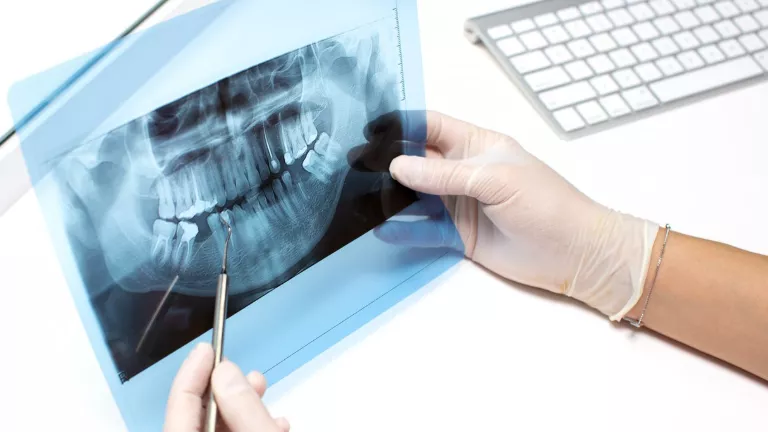
A successful Sausage Technique procedure begins with detailed digital planning. At our clinic, panoramic X-rays, CBCT, also known as three-dimensional dental tomography, and digital intraoral scanning systems can be evaluated together. Thanks to these technologies, the actual extent of bone loss, sinus anatomy, the position of nerves and the future positions of implants can be analyzed more clearly.
Three-dimensional imaging is highly important for surgical safety, especially in cases with advanced bone deficiency. Bone width and height are examined with millimetric precision. This allows the location, amount and form of the graft to be planned in advance. This approach contributes to a more controlled surgery and a more predictable treatment outcome.
Digital planning also makes it possible to evaluate the relationship between the implant and the prosthesis. Because the goal of successful implant treatment is not only to place the implant into the bone. The tooth to be placed on the implant must also be in the correct position in terms of chewing, aesthetics and bite alignment.
Local Anesthesia or General Anesthesia Option
Bone grafting procedures performed with Sausage Technique can be carried out under local anesthesia depending on the scope of the case. In more limited bone deficiencies, local anesthesia may be sufficient for patient comfort. During the procedure, the surgical area is numbed, and the treatment is completed without the patient feeling pain.
In more extensive bone reconstruction procedures, operations combined with sinus lifting or cases where the patient has high surgical anxiety, general anesthesia or sedation option can be considered. This decision is made by taking into account the patient’s general health status, the duration of the procedure, the size of the surgical area and expectations.
The aim is not to apply the same protocol to every patient, but to plan a safe and comfortable treatment process suitable for the patient’s needs. Therefore, anesthesia selection should also be evaluated individually.
Advanced Bone Deficiency Treatment with Sausage Technique in Istanbul Beyoğlu Galata
At our clinic in Istanbul Galata, advanced bone deficiency treatment with Sausage Technique is evaluated with three-dimensional digital analysis and personalized surgical planning. Advanced implant surgery, guided bone regeneration, sinus lifting operations and pre-implant bone reconstruction can be planned together according to the patient’s bone structure and treatment needs.
In patients who have been toothless for many years, developed severe jawbone resorption or were previously told that implants could not be placed, implant treatment may become possible again with the correct techniques. The most important step in this process is to accurately determine the level of bone loss and choose the appropriate surgical method for the patient.
Sausage Technique is a valuable treatment method that aims to create a strong, protected and biologically supported bone area for implants in patients with advanced bone deficiency. In Istanbul Beyoğlu, a personalized treatment plan can be prepared after a detailed examination for advanced bone deficiency treatment, pre-implant bone formation and jawbone reconstruction.